


The Phantom Mission
How an Unclear Purpose Can Kill Your Nonprofit’s Impact
Few things are as inspiring as a nonprofit mission statement. They're beautifully crafted, filled with hope, purpose, and a vision for a better world. Unfortunately, the road between those words and the organization's day-to-day work is often long, confusing, or in some cases, nonexistent. Somewhere between the stated mission and the decisions made every day, a "phantom mission" can quietly take over. It's the mission that never appears in the carefully written statement hanging on the wall, but becomes the force that actually drives priorities, behaviors, and choices. Here are five examples of well-intentioned nonprofits that have drifted from their stated purpose and some practical ways to recognize when your own organization may be heading off course and how to realign with the mission that matters most.
1. The Advocacy Add-On
Home For Good was founded to provide direct services to people experiencing homelessness. Its contracts funded shelter operations, housing navigation, case management, and other critical client support services. Over time, however, the organization's leaders became convinced that lasting change required more than direct service but also influencing the policies and ordinances that shaped the systems affecting their clients. As a result, an increasing share of funding was directed toward advocacy campaigns, policy coalitions, public awareness efforts, and staff participation in legislative and community forums. While these efforts were well-intentioned, they gradually moved the organization away from its stated mission and toward a different, unofficial mission centered on policy change rather than direct client services.
PRO-TIP: Advocacy may be absolutely central to your work. If it is, put it in the strategic plan. Budget for it. Staff it. Measure it. Explain it to the board and funders. The problem is not advocacy. The problem is pretending advocacy is free.
2. The Values-Based Vendor
AccessAbility Now had a clear mission to expand access, independence, and support for disabled clients and their families. They also had a strong organizational value around supporting women-owned, BIPOC-owned, local, and mission-aligned vendors. So when they needed a new consultant, caterer, printer, designer, or contractor, they often chose the values-aligned option, even when it cost more. Costs increased over time, which hindered their ability to fully serve their mission.
PRO-TIP:
Values-based spending may be the right choice, but values are not free. If your organization is willing to pay more for vendors because of ownership, geography, lived experience, community connection, or identity, decide that openly. Set a policy. Define the premium you are willing to pay. For example, “We are willing to pay up to 10 percent more for vendors who meet our values-based procurement criteria.”
3. “We Only Do What We Get Paid For”
Youth Forward had a mission to support low-income students through academic enrichment, mentoring, and college access. Over time, their program model started looking less like a strategy and more like a collection of funded opportunities. A grant for STEM? They added STEM. A grant for mental health? They added wellness groups. A city contract for summer employment? They added workforce programming. Individually, every program made sense. Collectively, the organization had become a menu of funder interests.
PRO-TIP: Nonprofits need funding, nobody gets extra credit for being mission-pure and insolvent, but chasing every available dollar can slowly turn an organization into a contractor for other people’s priorities. The question is not simply, “Can we get paid for this?” The better question is, “Would we still choose to do this if the money were unrestricted?” Some restricted funding is worth taking but some is not. A grant that pulls your staff, brand, data systems, reporting structure, and leadership attention away from the core mission may cost more than it pays.
4. The No-Margin Martyr
Community Care Collective was proud of how much it stretched every dollar. They kept administrative costs low, underpriced contracts, and avoided building reserves because “the money should go to the clients.” As a result, when the roof needed repair, there was no cushion to pay for it. When the database failed, there was no capacity to replace it quickly. Salaries fell behind the market, driving staff turnover. The organization could not launch a new program without a funder paying for every penny, and even a single late reimbursement was enough to trigger a cash crisis.
PRO-TIP: There is a reason people say “no margin, no mission.” Because it is true. A nonprofit that never generates margin cannot protect its mission. It cannot invest in infrastructure, retain good people, manage risk, or respond to opportunity. Organizations need to plan for the unplanned like a delayed payment, a lost grant, a bad fundraising year, or a surprise expense. The mission does not get stronger when the organization is financially fragile.
5. The Board Pet Project
The board chair at Healthy Futures was passionate about public awareness campaigns. Another cared deeply about financial literacy. A major donor wanted the organization to explore hosting an annual community festival. None of these ideas were inherently bad, so the staff made room for them: a small pilot program, a few exploratory meetings, a consultant proposal, a board committee, and eventually a new slide in the strategic plan.The organization never formally changed its mission. It simply kept saying yes. Over time, those small accommodations added up. Staff found themselves spending hundreds of hours pursuing initiatives that sounded worthwhile but had little connection to the organization's core outcomes. What began as an effort to be responsive gradually became a drain on focus, resources, and impact.
PRO-TIP: Money is not the only resource that gets drained. Leadership attention may be even more limited. Every new idea requires staff time, emotional energy, meeting space, follow-up, and decision-making. Even when the financial cost is small, the organizational cost may be high.Boards should be especially careful here. A casual suggestion from a board member can become three weeks of staff work. Before adding anything, ask: “What should come off the list if this goes on?” If the answer is nothing, the organization is probably lying to itself.
The Final Test
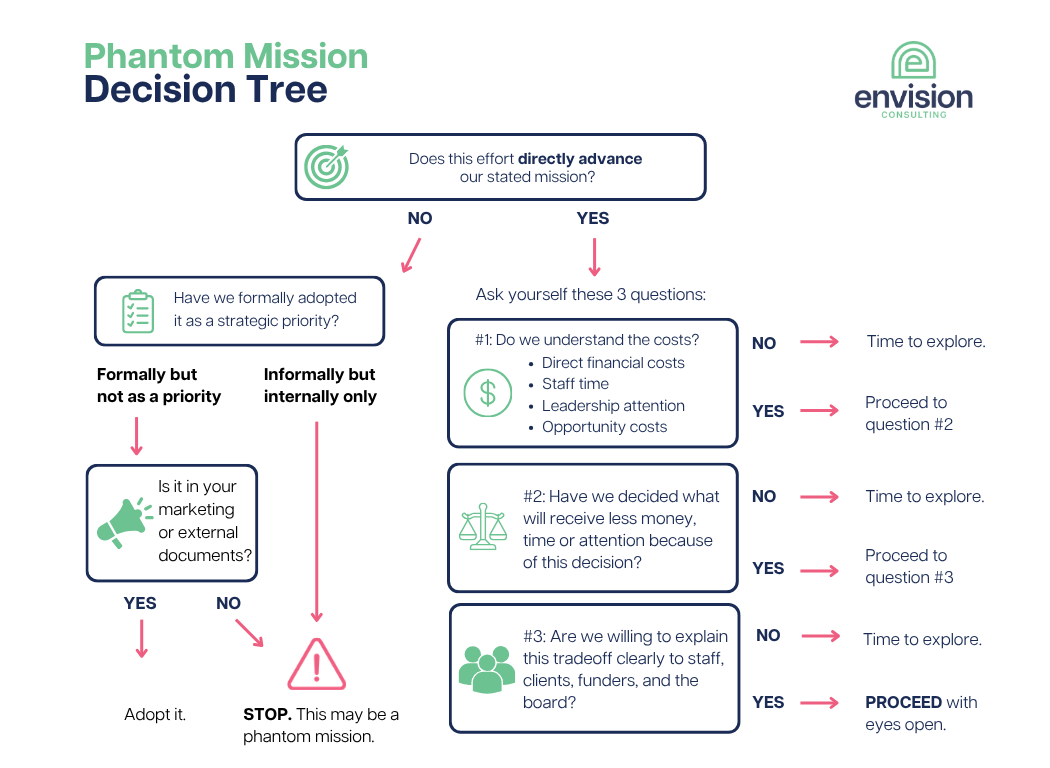
Before you approve the next grant, vendor, coalition membership, pilot program, advocacy campaign, or board-driven idea, ask yourself these questions: